A practical guide to beds and foundations
Platform Frames and Mattress Compatibility: A Practical Guide
A platform bed can make a bedroom feel beautifully composed: a clean silhouette, a considered profile, and no need for a separate box spring in many setups. But the frame beneath the mattress is more than a design decision. Slat spacing, centre support, dimensions and weight limits all matter—and the right foundation depends on the mattress it will hold.
Published November 13, 2026
What makes a bed a platform frame?
A platform frame is a bed structure designed to support a mattress directly, usually on a solid deck, closely spaced slats or a combination of support rails and slats. Because the frame itself supplies the foundation, a separate box spring is often unnecessary. That streamlined arrangement can simplify a bedroom’s furniture plan and give a mattress a lower, more tailored profile.
The phrase “platform bed” describes a broad family of designs rather than one standard construction. Some frames have a continuous, solid surface; others use a slatted base. A few have a broad upholstered perimeter or a low footboard, while their hidden support systems differ considerably. Two frames that look nearly identical from across the room may therefore offer different support conditions once the mattress is in place.
That distinction matters because a mattress is engineered to rest on a particular kind of foundation. Support that is too widely spaced, uneven or insufficiently reinforced may affect how the mattress sits and performs. Before choosing a frame, look beyond its finish and height to the structure beneath the mattress.
Start with the mattress manufacturer’s requirements
The most reliable starting point for platform frame mattress compatibility is the mattress maker’s care and warranty information. Recommendations can vary by model, even among mattresses that share a broad type. Check what the manufacturer specifies for foundation style, maximum slat spacing, centre support and use with adjustable or solid bases.
Do not assume that every slatted platform is suitable simply because it is sold as a bed frame. Nor should you assume that a solid deck is always the best option. The correct surface depends on the mattress construction and the stated requirements. If the information is unclear, ask the manufacturer or retailer for guidance on the exact mattress and frame combination you are considering.
Keep a copy of those requirements with your purchase details. If questions arise about fit, performance or warranty coverage later, it helps to know what support system was recommended and how the frame was assembled. Following the instructions is a small act of due diligence that can protect a much larger investment.
Slat spacing: the detail that hides in plain sight
Slats distribute the mattress’s weight across a series of supporting rails. The distance between them—the slat spacing—is one of the most important details to confirm. If the gaps are wider than the mattress manufacturer permits, portions of the mattress may lack the continuous support its construction requires. The result can be an uneven sleeping surface or additional strain on materials over time.
Measure the clear gap between adjacent slats rather than estimating from a photograph or product description. If a frame has flexible, curved or closely arranged slats, confirm that the complete arrangement is approved for your mattress; appearance alone cannot establish compatibility. Also check whether slats are secured against shifting. A support system that moves out of position may no longer provide consistent coverage.
There is no universal spacing number that applies to every mattress. Foam, latex, hybrid and innerspring designs can have different foundation requirements, and individual manufacturers may set specific limits. The safest approach is to compare the frame’s stated measurements with the requirements for the exact mattress model.
- Ask for the slat spacing in writing if it is not listed clearly.
- Check whether the measurement refers to the gap between slats or their centre-to-centre distance.
- Confirm whether the frame includes a centre rail and support legs, especially in wider sizes.
- Follow the mattress maker’s guidance on any additional foundation or bunkie board.
Innerspring mattress support
An innerspring mattress uses a system of coils as a central part of its support. That does not mean all innerspring mattresses require the same base. Some are designed to sit on slats, while others specify a particular foundation or demand more continuous support. Construction, coil system, perimeter reinforcement and the manufacturer’s testing all influence the recommendation.
For an innerspring mattress on a platform frame, check the allowed slat spacing and whether the base has robust support through its centre. A queen or larger mattress may need a centre rail or other reinforcement, depending on the frame’s design. Without adequate support, the middle of the bed may bear more load than intended, particularly when two people share it.
A platform frame can be a convenient alternative to a box spring when the mattress maker permits direct placement on the frame. The benefit is not merely fewer components: it can make the overall bed profile easier to tailor to the room. But “no box spring required” is not a substitute for checking the frame’s support layout, load capacity and compatibility with the mattress.
Organic mattresses and foundation choices
Organic mattresses may use materials such as natural latex, wool or cotton, but the word “organic” alone does not determine the correct foundation. Different models may use distinct layer arrangements and support systems. Read the product’s specific foundation guidance, just as you would for an innerspring mattress, and verify that the platform frame meets it.
Ventilation is another consideration. A slatted structure allows air to circulate beneath the mattress, while a solid deck offers a more continuous surface. The better choice depends on the mattress maker’s instructions, the room and the conditions in which the bed will be used. Do not add a layer intended to improve airflow or support unless the manufacturer approves it; an unapproved base or accessory can change how the mattress is supported.
Consider the complete setup, not only the mattress label. A mattress protector, topper or other bedding layer can affect the finished height and feel of the bed, though it does not replace a proper foundation. If a topper is part of your plan, confirm that fitted sheets will accommodate the combined mattress depth and that the frame still supports the mattress as required.
Dimensions, weight capacity and centre support
Even a well-constructed platform frame will not serve properly if its dimensions do not match the mattress. Compare the frame’s internal sleeping area with the mattress dimensions, rather than relying only on the named size. Names such as queen or king can be useful shorthand, but exact measurements offer greater certainty, particularly when choosing furniture across different standards or markets.
Also check the frame’s stated weight capacity. The relevant load may include the mattress, sleepers and, depending on the manufacturer’s definition, additional weight from bedding or movement. Ask whether the listed capacity applies to the whole frame or to each side, and whether the rating changes by size. Never infer capacity from the apparent thickness of a rail or the visual solidity of the design.
Centre support is especially important on wider frames. A central rail, often supported by legs that reach the floor, can help distribute weight along the length of the bed. Verify that these supports are present, assembled correctly and in contact with the floor as intended. If flooring is uneven, use the manufacturer’s approved adjustment method rather than improvising a fix that could destabilise the structure.
Bed height deserves a place in the planning, too. The combined height of frame, mattress and topper determines how the bed meets the room and how it feels to get in and out. A low platform may create a calm, architectural line; a taller arrangement may be more practical for some households. Measure the full setup before buying, taking account of bedside tables, nearby drawers and the clearance needed for everyday use.
Ventilation and the surface beneath the mattress
Airflow beneath a mattress can be worth considering in the context of the room’s humidity and the foundation design. Slatted frames leave open areas below the mattress, whereas solid platforms create a more continuous surface. Neither construction should be selected on ventilation claims alone: compatibility and manufacturer instructions take precedence.
Keep the space around the bed clean and follow the mattress and frame care directions. If the manufacturer recommends periodically lifting or airing the mattress, do so safely and according to its instructions. Avoid blocking ventilation paths with storage or fabric where the frame design relies on them, and check from time to time that slats, rails and fastenings remain secure.
A considered frame choice: form meets function
The appeal of a platform frame is partly practical and partly visual. With its support built into the frame, it can give a bed a composed, uncluttered presence. Upholstery softens the outline; solid wood brings grain and warmth; a low footboard can preserve an open view across the room. Yet the most elegant choice is the one whose structure is suited to the mattress as well as the interior.
For example, the Upholstered Bed Frame pairs an upholstered frame with a wooden slatted base designed to support a mattress without a separate box spring or foundation. Its broad ledge extends around the perimeter, and the frame is offered in three textile options. As with any platform design, confirm the slat measurements, dimensions and weight capacity against the requirements of the mattress you intend to use.
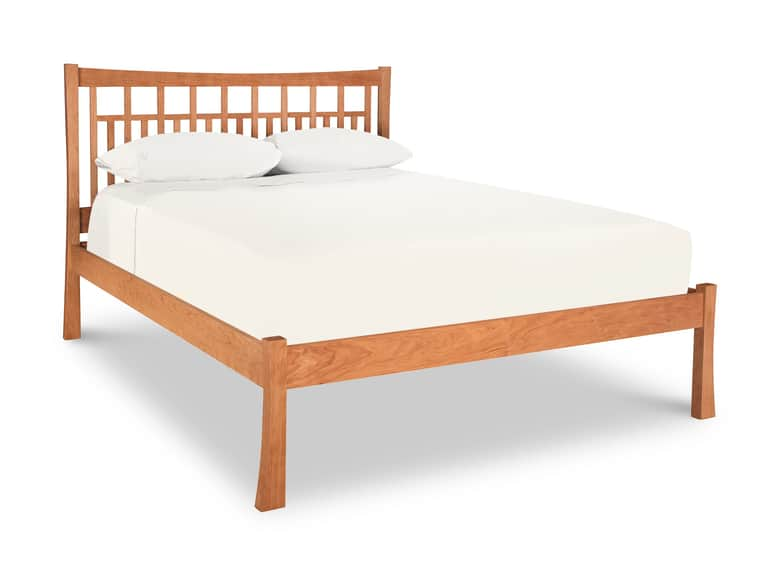
For a more substantial expression in solid wood, the Contemporary Craftsman Low Footboard Bed is described as a solid wood platform bed with Arts and Crafts styling and an oil finish. Its low footboard lends the silhouette a measured, grounded quality. Before pairing it with a mattress, consult the maker for details about the support surface and any model-specific requirements not provided in the product description.
These examples illustrate a useful principle: design language and foundation performance should be considered together, but they are separate questions. A frame can be beautifully made and still require closer inspection for a particular mattress. Conversely, an understated base may be an excellent match if its construction meets the mattress specifications.
Assembly and ongoing checks
Correct assembly is part of mattress compatibility. Follow the frame instructions in sequence and use the hardware supplied or specified by the maker. Confirm that rails are aligned, slats are evenly positioned and all supports are secured before placing the mattress. If the frame includes adjustable components, make sure they are set to the intended position and locked as directed.
After the bed is in use, listen for new movement or shifting and inspect the structure periodically. A loose connection or displaced slat can interrupt an otherwise even support surface. Tighten or adjust parts only as described in the instructions, and contact the manufacturer if a component is damaged or if the frame behaves unexpectedly.
When moving the bed, avoid dragging a loaded frame across the floor. Lifting and repositioning it according to the maker’s advice can help protect joints and fasteners. If you disassemble the frame, keep its hardware together and retain the instructions; a careful rebuild is easier when every part can be identified.
A concise compatibility checklist
Before making a final decision, compare the mattress and frame details side by side. A few precise questions can prevent a costly mismatch and make it easier to choose a bed that feels as considered as it looks.
- Mattress guidance: Does the manufacturer approve the intended platform or slatted base?
- Slat spacing: Is the measured gap within the mattress maker’s stated limit?
- Support structure: Are centre rails and legs included where needed for this size?
- Dimensions: Do the frame’s internal measurements suit the mattress exactly?
- Capacity: Is the frame rated for the expected total load?
- Surface and airflow: Does the frame’s construction align with the mattress instructions and room conditions?
- Warranty: Does the proposed setup meet both frame and mattress requirements?
- Finished height: Will the mattress, topper and frame work with bedside furniture and room clearances?
The bottom line
Platform frames offer a refined, efficient foundation, but their suitability is specific rather than universal. The decisive details are often the least visible: slat spacing, reinforcement, dimensions and construction. Innerspring and organic mattresses may both work beautifully on a platform, provided the exact mattress and frame are designed to work together.
Begin with the mattress manufacturer’s requirements, verify the frame’s measurements and capacity, and assemble the support system precisely as instructed. With those practical checks in place, choosing a platform bed becomes a more confident exercise in proportion and material—one in which the foundation is as thoughtfully considered as the room it anchors.